01
A game, not a prototype
180 stages, 10 chapters with story and voice-over. 12 heroes — 6 classes × male/female — and 24 second-job forms. 124 monster and boss types, 434 skills.
Featured project / 2026
A mobile idle RPG
in the world of Ragnarok Online
A familiar world. A new story.
Five heroes — and tactics that decide the battle.
Solo project: idea, product and game design; built with AI agents.
The project’s story and structure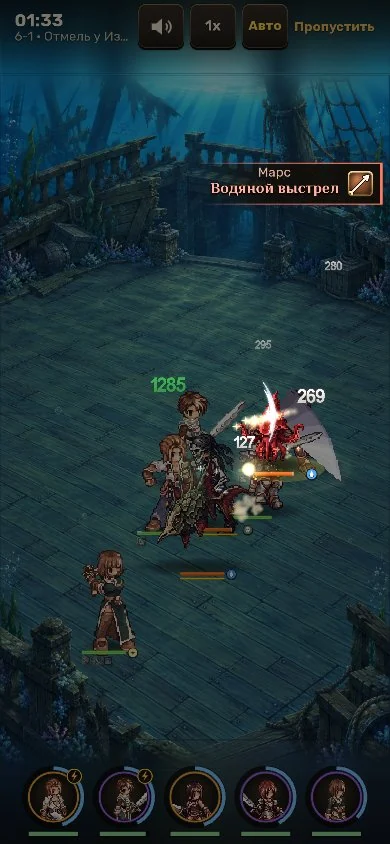
01 / About the project
Chronoworld is a mobile idle RPG in the AFK Arena genre, with the world and art of Ragnarok Online. You build a squad of five heroes and play through a story campaign of ten chapters.
Battles run automatically, but victory starts before the first blow: lineup, positioning, ultimates and gear. Between battles come levelling, ascension through the rarities and the choice of a second job.
The game already runs in the browser on a phone. Telegram Mini App support is built in too.
02 / Scale
Recounted from the repository on 20 Oct 2026.
Not audience figures.
180 stages, 10 chapters with story and voice-over. 12 heroes — 6 classes × male/female — and 24 second-job forms. 124 monster and boss types, 434 skills.
A deterministic core with no game engine and no randomness outside the seed. Thousands of battles help check the balance, and any bug can be reproduced.
Units, skills, chapters, story and economy are stored in JSON with strict validation schemas. A new monster or chapter needs no code changes.
A model of a “live” player lives through 7–28 days: sessions, the idle chest, summons and upgrades. The economy, progress walls and Tower difficulty are tuned against it.
A Tavern with summons and pity guarantees, ascension, gear and refining, a roguelike Tower, a Hunt for MVP bosses, expeditions, a Kitchen with dishes of the day, a Shop, quests and achievements. A daily loop, and in Telegram — cloud saves and online leaderboards.
1,078 lines in Russian. The story voice-over was synthesized with ElevenLabs.
RU/EN localization, a responsive interface and Telegram safe areas. The game runs in the browser; Telegram Mini App support is already built in.
About 2,200 automated tests, “player path” smoke tests on real model states, local e2e runs in the browser and CI on every PR.
1,177 commits and 163 pull requests in ~3.5 weeks since 26 Sep 2026. I set the tasks, made the design and balance decisions, and tested. AI agents wrote the code and tests and ran audits.
04 / Inside Chronoworld
Real game screens. Swipe through or open any shot.
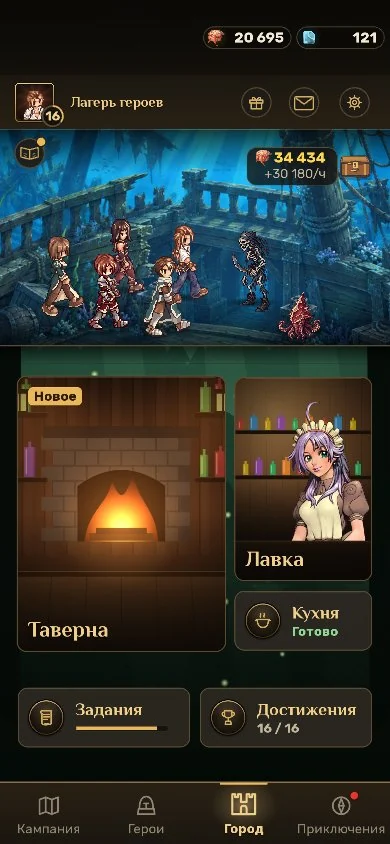
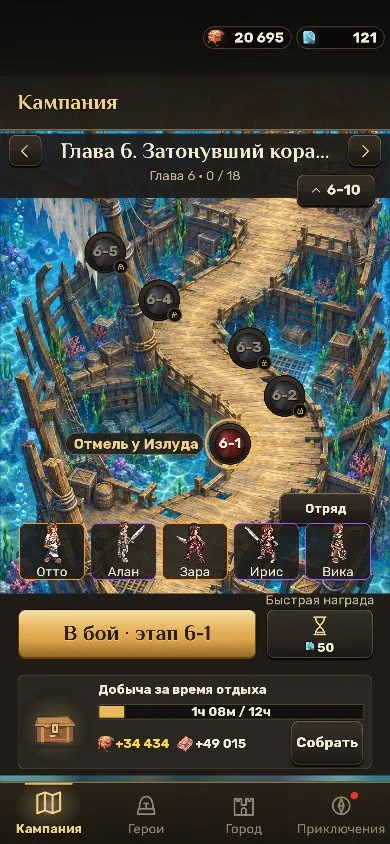
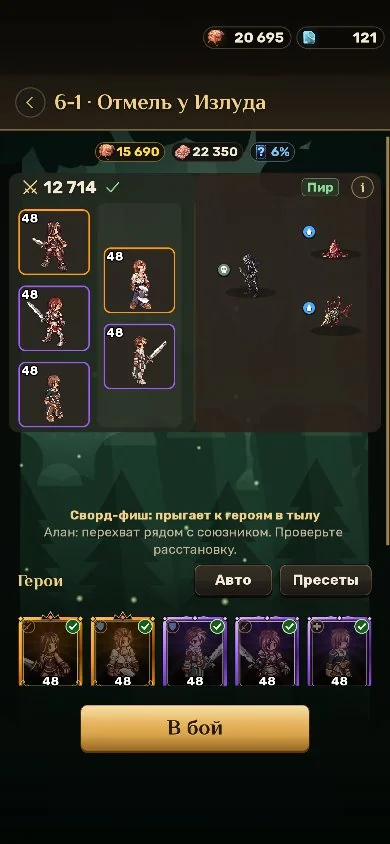
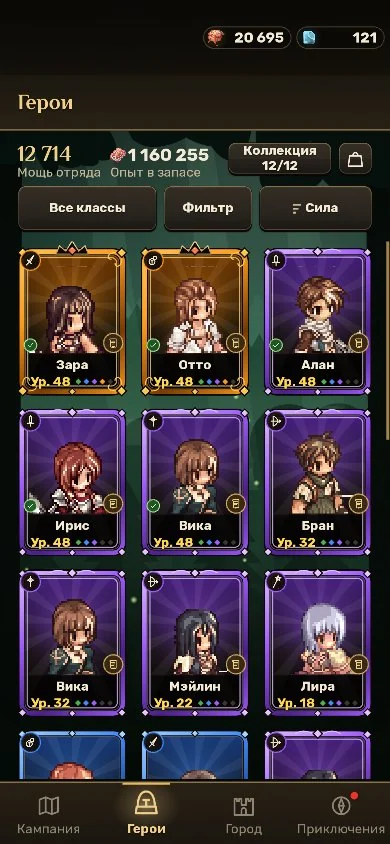
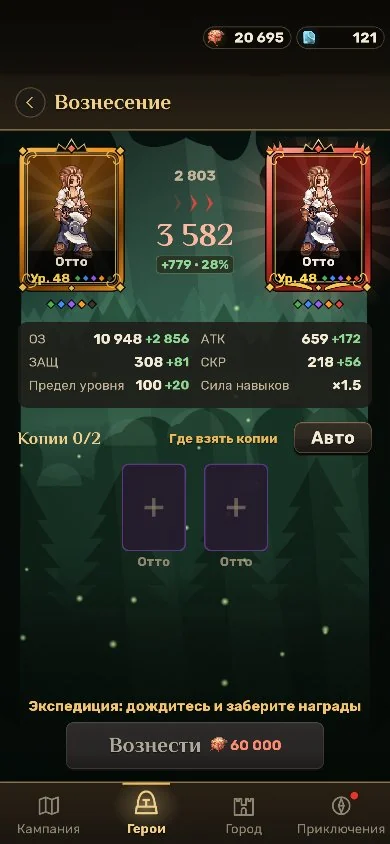
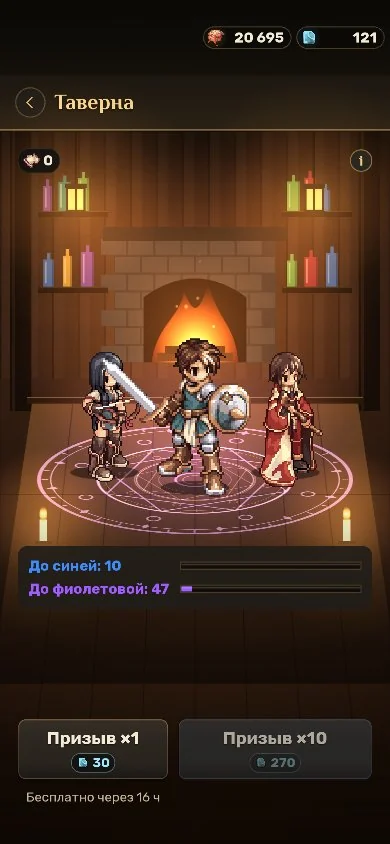
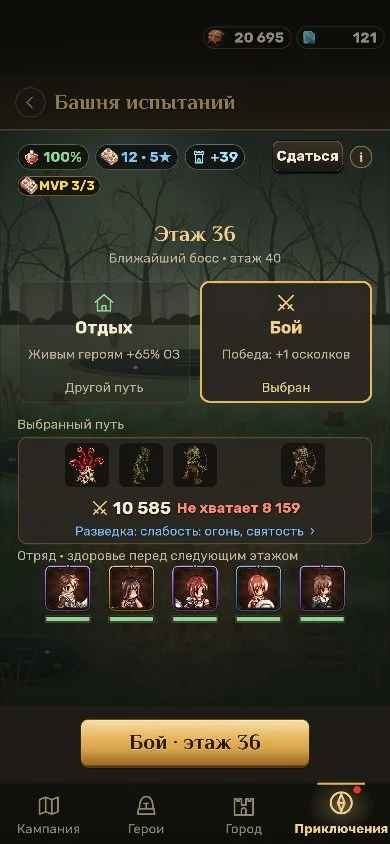
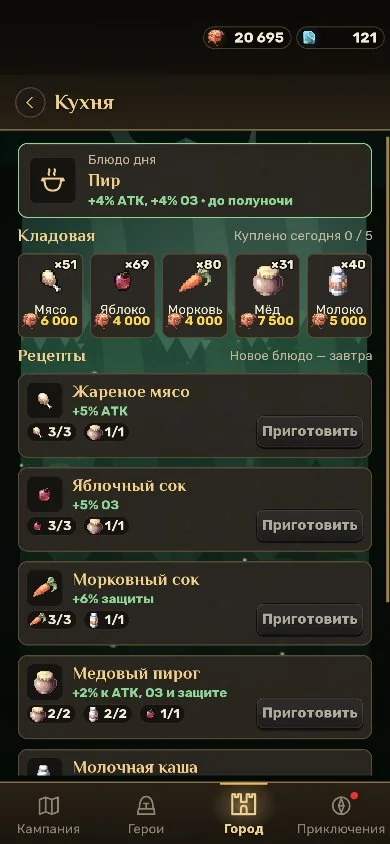
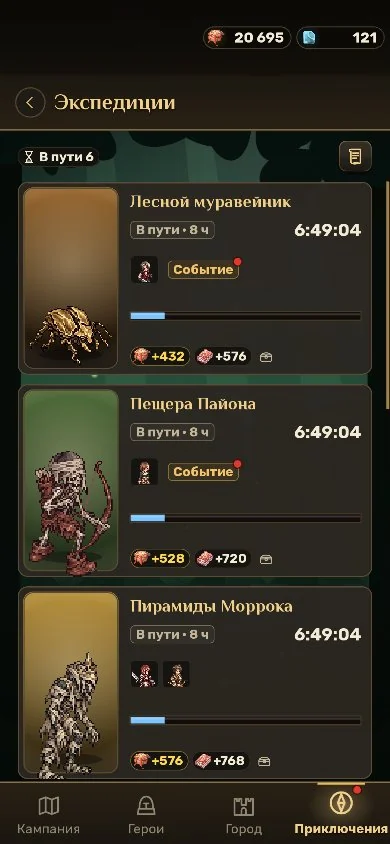
Auto-battle · hero ultimate
From the town to distant expeditions
Tap a thumbnail to view it in full
Supabase: cloud saves, leaderboards and the Telegram bot. Vite: WebP copies and a loading bundle for a fast start.
data/*.json and strict schemas describe units, skills, chapters, story and economy. Content is separate from logic: a new monster or chapter is added without changing code.
≈ 76K lines of game code
≈ 37K lines of tests
≈ 18K lines of scripts
Five business-analysis artifacts reconstructed from the game’s repository. Every rule and number was checked against a file — the path is given in the caption. The project was run on plans, reports and tests; the diagrams and stories were drawn up from them after the fact.
7.1 · Process diagram
The core of an idle RPG is a short cycle: preparation, auto-battle, reward, growth. Around it run two longer loops: the idle chest and expeditions work while the player is away, and the daily activities reset at midnight and give a reason to come back tomorrow.
Simplified: 15 steps and systems and one decision point. Not shown: the Tower (its run does not reset at midnight), achievements, mail and the story. Numbers are from the game data as of 20 Oct 2026.
Source: data/progression.json:20-42 · data/quests.json:3-23 · data/summon.json:4-48 · data/expeditions.json · data/hunt.json · data/shop.json · data/kitchen.json · data/autobattler.json:7-8, 250-255 · data/events.json:4-27 · data/drops.json:182-183, 368-409 · data/cards.json:4-48 · src/core/campaign/offline.ts:100-160 · src/game/flow.ts:388-400 · src/game/battleMode.ts:1-6
Model14 days of 3 sessions, seeds 1–3: 69% of gold comes from the idle chest, and Daily Quests give 41–44% of all gems. This is a player model, not player data; more in section 7.3.
The roguelike Tower (the run does not reset at midnight; gems for a floor record), achievements, mail, the story and evenings in the Tavern.
7.2 · User journey
Features unlock one at a time — after the first victory on a specific stage, as in AFK Arena. What the player sees and when — from the game data, the audit of the first 30 minutes and the player model; alongside — what the checks found and what was fixed, and what remains open.
Unlock ladder: 12 features over the first 27 stages. The number is “chapter-stage in order within the chapter”, as in the game (Tavern — 1‑6; the daily loop document records the same unlocks by stage id — “1‑5”).
Source: data/unlocks.json:4-96 · src/core/unlocks/unlocks.ts:57-63 · data/campaign/chapter1.json · data/campaign/chapter2.json
Times in the “Player model” row come from the model, not from real players: sessions start at 8:00, the first lasts 10 minutes, the rest 7 each, battles at ×1.5 speed. The model’s active minutes are fewer than real time. There are no emotions or personas here: the repository has no data on them.
01 · first 10 minutesstages 1-1…1-8
02 · first daystages 1-9…1-18
03 · days 1–3the first “walls”
04 · days 2–7ascension
05 · second weekdaily routine
06 · days 8–21chapters 4–10
Source: docs/qa/first-30min-2026-10-10.md · src/game/hints.ts:264-266 · tests/game-hints.test.ts:62 · docs/design/daily-loop-2026-10-10.md:41-92 · docs/content/balance.md:1031-1047 · data/events.json · data/summon.json:32-41 · scripts/lib/player-model.ts:212-244 · data/progression.json (recommendedStages.ch10_s13 = 0.3066 — the lowest of 180)
7.3 · Quantitative analysis
The player model plays the game through the functions of the same core, with real battles. Nine runs — 2, 3 and 4 sessions a day, three seeds each: how many stages are cleared by the end of each day and where the earned gold goes. This is a model, not player data.
9 runs of 21 days: 2 sessions a day — 8:00 and 20:00, 3 — 8:00, 14:00, 20:00, 4 — 8:00, 12:00, 16:00, 20:00; the first session lasts 10 minutes, the rest 7 each, no more than 3 defeats per stage per session, and the model doesn’t play the Arena. Three seeds are a minimal estimate of the spread, not a distribution of players. The plateau at 174 is stage 10-13 “Citadel Courtyard”: its recommended-power coefficient of 0.3066 is the lowest of 180, and the model lost there at 118–141% of the recommended level. Recalculated on 20 Oct 2026 on a copy of the repository; a rerun gave a byte-for-byte identical result.
Source: scripts/balance.ts:40-48 · scripts/lib/player-model.ts:212-244 · data/progression.json (power.recommendedStages) · npm run balance -- --days 21 --sessions 2|3|4 --seed 1|2|3
| Sessions a day | Day 7 | Day 14 | Day 21 |
|---|---|---|---|
| 2 | 59 | 101 | 146 |
| 3 | 85 | 145 | 180 |
| 4 | 93 | 169 | 180 |
Stages cleared by the end of the day: the median of three seeds, with the worst and best seed next to it. The short plateau at 153 (3 sessions, seed 1, days 15–17) is stage 9‑10: there the squad’s power was below the recommended level (0.87–0.92), an ordinary “wall”.
| Day | 2 sessions | 3 sessions | 4 sessions |
|---|---|---|---|
| 1 | 17 16–17 | 23 21–23 | 26 26–26 |
| 2 | 26 25–26 | 33 29–35 | 35 35–41 |
| 3 | 31 31–33 | 46 41–46 | 46 45–53 |
| 4 | 39 38–41 | 57 51–58 | 60 57–62 |
| 5 | 46 46–46 | 67 60–67 | 74 72–74 |
| 6 | 53 51–54 | 76 72–77 | 85 85–85 |
| 7 | 59 58–62 | 85 82–88 | 93 90–94 |
| 8 | 67 67–70 | 93 90–94 | 100 100–103 |
| 9 | 74 73–76 | 100 98–103 | 112 100–116 |
| 10 | 81 80–83 | 109 106–111 | 122 112–128 |
| 11 | 87 87–88 | 119 114–122 | 136 126–141 |
| 12 | 91 90–94 | 126 122–133 | 147 140–154 |
| 13 | 97 95–101 | 137 130–141 | 159 152–166 |
| 14 | 101 101–107 | 145 141–150 | 169 163–178 |
| 15 | 109 107–114 | 153 148–159 | 174 173–180 |
| 16 | 116 115–121 | 158 153–167 | 180 174–180 |
| 17 | 122 121–127 | 166 153–174 | 180 174–180 |
| 18 | 128 126–135 | 175 161–180 | 180 174–180 |
| 19 | 134 132–141 | 180 169–180 | 180 174–180 |
| 20 | 141 141–147 | 180 174–180 | 180 174–180 |
| 21 | 146 145–152 | 180 174–180 | 180 174–180 |
The same model run: 3 sessions a day, 14 days, the sum of three seeds. A check of the goal “gold doesn’t pile up idle”: almost everything earned is spent. Once items are refined to +10 (around day 19–20 in the 21-day run), gold starts piling up again.
| Idle chest | 69.3% | |
|---|---|---|
| Campaign victories | 14.5% | |
| Fast Rewards | 6.9% | |
| Tavern (gold rewards) | 4.1% | |
| MVP Hunt | 3.1% | |
| Expeditions | 2.0% | |
| Other: Tower, quests, achievements, events, mail | 0.2% | |
| 67.3 million gold received over 14 days (sum of three runs). | ||
| Gear refining | 48.2% | |
|---|---|---|
| Heroes: levels and ascension | 32.5% | |
| Shop | 19.3% | |
| Kitchen (ingredients) | < 0.1% | |
| 67.1 million spent — 99.4–99.8% of the earnings, depending on the run. Refining’s share across runs — from 35 to 54%. | ||
Shares of the sum of three 14-day runs. “Heroes” — levels, ascension and branch change.
Source: scripts/lib/player-model.ts:374, 614-650 · npm run balance -- --days 14 --sessions 3 report, “Economy” block
7.4 · Requirements and decisions
First — how the owner’s wish became measurable goals. Then — five balance and product decisions: the problem, the data behind the decision, what was done and what came of it. Where a goal was not met, it says so.
“Balance that’s interesting, so there’s a hook — I’m about to level up my character, they’ll get stronger, like in AFK — but there’s waiting involved too.”
| Goal | What we wanted | Model metric | Recalculated 20 Oct | Status |
|---|---|---|---|---|
| G1 | First 30 minutes: a level-up every 1–2 battles | battles per level-up | 0.52–0.60 (25–26 battles, 43–50 level-ups) | on target |
| G4 | Tavern at 1-6 and the first ×10 right away | active minute of the first ×10 | 7th minute, with scrolls from the gift | on target |
| G5 | Chapter 1 — 30–45 minutes of active play | active minutes to the 1-18 boss | 20 model minutes; browser audit — 15.7 min with “Skip”, ≈ 30 min watching | below target |
| G6 | Chapter 2 — days 1–2, chapter 3 — days 3–5 | hours from the first session to the end of the chapter | chapter 2 — 32 / 56 / 52 h, chapter 3 — 84 / 80 / 76 h | chapter 3 — on target, chapter 2 — for 1 seed of 3 |
| G8 | Defeats — at 85–95% of recommended power, not lower | defeats below 85% | 0 / 0 / 6 | for 2 seeds of 3 |
| G10 | Gold and XP get spent instead of piling up idle | share spent over 14 days | gold — 99.4–99.8%, XP — 50–91% | gold — yes; XP piles up at the rarity cap |
Source: docs/content/balance.md:14-31 · npm run balance reports (“Hooks”, “Economy” blocks)
Results come from the player model and autotests, not from real players’ behaviour. Dates follow the sections of the project log. The “no replays of cleared stages” decision is not included: the repository has no measured data on it; it is covered in story US4.
Source: src/game/battleMode.ts:1-6 · docs/PROGRESS.md:149-154 · docs/design/battle-decisions.md:40-45 · tests/battle-decisions.test.ts:56, 73
openThe 21-day recalculation of 20 Oct: once items are refined to +10 (≈ day 19–20), gold piles up in the millions again.
Source: docs/PROGRESS.md:251-275 · docs/PROGRESS.md:136 · data/drops.json:368-409 · tests/equipment-refine.test.ts:168, 309, 340
openThe goal “2–3 by day 5” is met for one seed out of three in the 20 Oct recalculation.
Source: docs/PROGRESS.md:13-16, 295 · docs/content/balance.md:1006-1029 · data/summon.json:8-48 · data/cards.json:15-20 · tests/heroes-summon.test.ts:46
Source: docs/design/daily-loop-2026-10-10.md:41-92 · data/quests.json · data/events.json:15-27 · tests/daily-loop.test.ts:38-110
Source: docs/content/balance.md:1031-1047 · docs/qa/first-30min-2026-10-10.md:70-71 · data/cards.json:11-14 · tests/smoke.test.ts:144
7.5 · Requirements and acceptance
Five user stories formulated from the code. Every acceptance criterion has an autotest that checks it — the file and line are given under the criterion. Three stories are linked to decisions from the log.